

Hello dear friend, I hope you are well today.
August is for thinking about our parenting, so we move.
What has been the most impactful thing we have shared so far for you? Think about it, and if you want to respond, send me an email or comment below.
I think it’s good for us to be conscious of how we parent and open to upgrading our operating system for success.
We cannot afford to parent on autopilot; it is way more important than anything else we invest in. It is the future. Me, I have become more conscious of how often I repeat myself at home, learning to give clear, concise instructions and clear consequences for disobedience.
It has helped me stay regulated and helped my kids understand boundaries better.
Me sef dey learn…

Parenting comes with enough quiet questions of its own without having to navigate everyone else’s loud opinions about how you should raise your child.
From the moment a child is born, parents begin hearing advice from relatives, friends, neighbours, older generations, social media followers, and sometimes total strangers: “You should be doing this.” “In our time, we did it differently.” “You are being far too soft on that child.”
Sometimes, the advice is genuinely well-intentioned. Other times, it feels intrusive, judgmental, or plain exhausting. The challenge, however, isn’t simply receiving advice; it is learning how to decide what deserves your attention and what you can respectfully leave behind.

Why Unsolicited Advice Hits So Hard
There is research that shows that receiving unasked-for guidance directly challenges two core human needs: autonomy (our sense of control over our own lives) and perceived competence (our belief in our ability to perform a task well).
When someone gives you unprompted parenting advice, your brain often interprets it not as a helpful gift, but as an implicit critique: “You aren’t handling this correctly.” This naturally triggers a self-defensive state known as cognitive rumination—where you find yourself replay-analysing the comment for hours or days afterwards.
Trust me on this one: I am an African firstborn daughter, and unsolicited advice is an essential part of the job yet the most despised part of the job. I get through backlash but also see beyond it. In my own life, I welcome advice and would consider it even though I don’t love it and also want to defend myself.
Recognizing that this emotional reaction is grounded in human psychology can help you pause, take a deep breath, and disarm the internal defence mechanism before it takes over.

Not Every Opinion Requires an Action
One of the most liberating truths in parenting is that someone having an opinion about your child does not obligate you to act on it. People routinely offer advice based on their own personal history, cultural background, generational habits, and hidden fears.
What worked for a cousin’s infant in 1995, or what worked for your own parents thirty years ago, may not align with current developmental science or your child’s unique temperament.
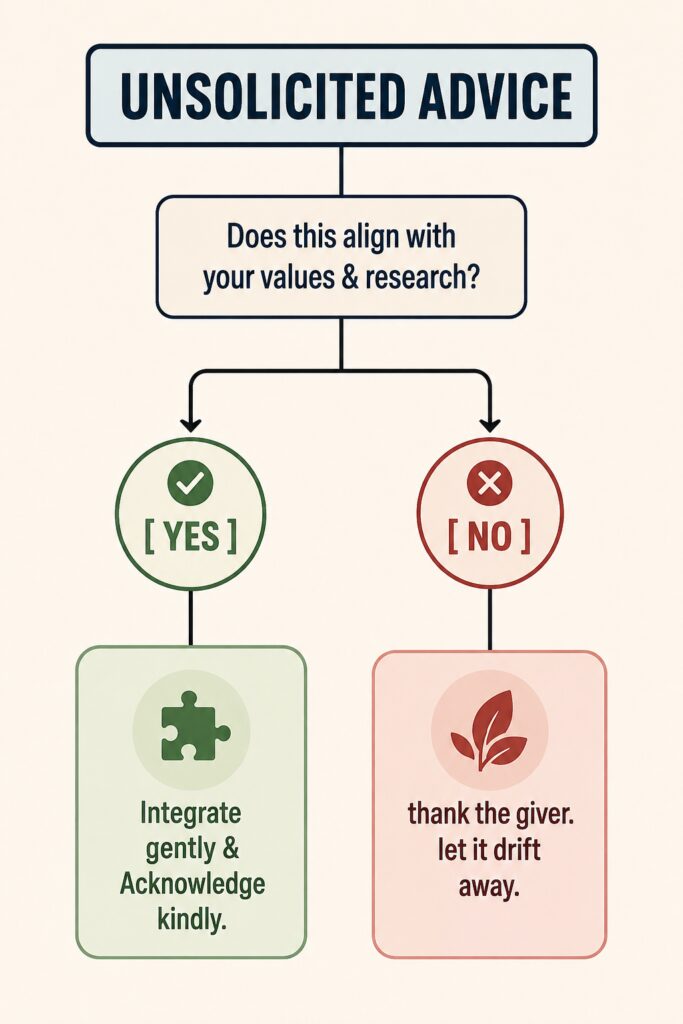
Reflection:
Think back to a piece of advice that recently frustrated you. Was the advice truly about your child’s actual needs, or was it a reflection of the advice-giver’s background and personal experiences?
Learn to Separate Guidance From Criticism
In adult relationships, clear communication hinges on distinguishing between informational support (sharing useful tools) and evaluative criticism (judging your abilities).
- Informational Support: “We struggled with bedtime routines around age four, too. What worked for us was a visual clock, but every kid is different.”
- Evaluative Criticism: “You let your child walk all over you. You clearly need to be stricter.”
The first opens a doorway to shared experience. The second attacks your parenting agency. Learning to spot the difference allows you to respond calmly without becoming defensive.
Setting Boundaries Preserves Community
Setting boundaries is not about building walls to isolate your family; it is about creating clear guardrails so your community can support you safely.
When you set a soft boundary, you protect your peace while preserving your relationships. You do not need a lengthy explanation, a scientific defence, or a heated argument.
| Situation / Advice Source | Direct, Kind Phrase to Use |
|---|---|
| Well-Meaning Relative | “Thank you for sharing what worked for you! We’ve chosen a path that fits our family’s routine right now.” |
| Passerby / Stranger | “Thanks, we’ve got it under control!” or a simple “I’ll keep that in mind.” |
| Repeat Boundary Crosser | “I know you care about us, but right now I’m not looking for advice—just your encouragement.” |
Protect Your Unified Front in Front of Children
Parenting conflicts become particularly tricky when adults challenge a parent’s authority right in front of the child. If a parent sets a firm boundary (“No screens before dinner”) and another adult interrupts (“Oh, let them have the phone, it’s fine!”), a child’s developing brain takes quick note.
Child development research calls this triangulation; children quickly learn to leverage adult disagreements to bypass rules. When disagreements happen, gently step in: “We are sticking to our family rule right now, but thank you.
Let’s chat about this together later over tea.” This approach models firm, calm boundary-setting for your child while treating the other adult with respect.
Subscribe to My Newsletter
Your Child Is Not a Group Project
Extended family and community networks offer rich, invaluable support. Grandparents, aunts, uncles, neighbours, and mentors enrich a child’s life with varied perspectives and extra love. However, support must never be confused with shared governance.
Your child is not a community project where every observer gets a vote.
As a parent, you are ultimately responsible for making decisions based on your child’s distinct personality, your home values, and current pediatric guidance.
THE PARENTING CORE
Decisions rooted in what matters most.
Driven by values, health guidelines, and unique child needs.
Support that strengthens, not controls.
Love, presence, warmth, and wisdom offered without control.
The goal is not to parent alone, but to receive support while remaining grounded in the decisions that are right for your family.
Create Space for Parents to Learn
Every parent is in active development. Whether someone is navigating parenthood for the first time, parenting a neurodivergent child, or trying to break generational patterns, they need empathy far more than instructions.
Instead of jumping in with solutions, we can strengthen our communities by asking a simple question: “Are you looking for a listening ear, or would you like to brainstorm ideas together?”
You can Support My Work
Reflection:
How can you offer supportive, non-judgmental presence to another parent in your community this week?
Final Thought
Parenting will always attract opinions. You cannot control what people offer, but you hold complete control over what you let across your doorstep. Listen where there is genuine wisdom.
Filter out what does not fit your home. Seek professional guidance when necessary. Set soft boundaries when people overstep. Your child doesn’t need a perfect parent who satisfies everyone else’s expectations. They simply need a thoughtful, grounded parent who is willing to learn, adapt, and lead with love.
Until next time — stay warm, stay growing, stay loving, stay whole.
With love and light
Amaka.